
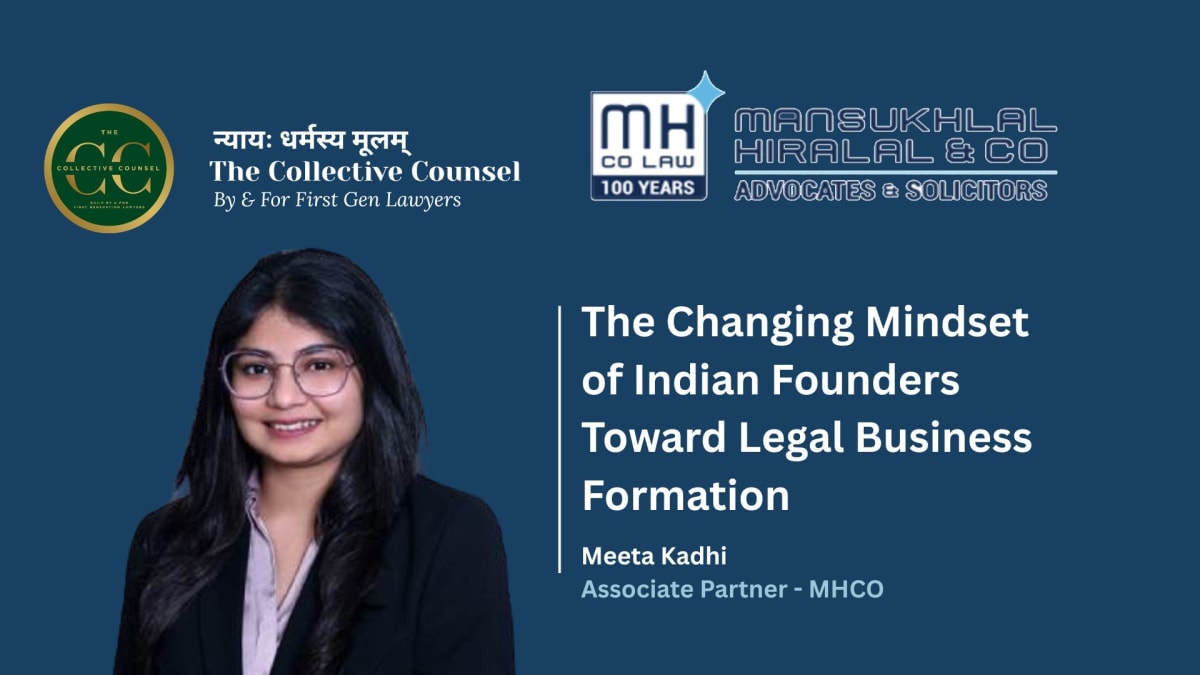
The Changing Mindset of Indian Founders Toward Legal Business Formation
India's startup ecosystem is witnessing a significant shift in how founders approach legal business formation. Rather than treating incorporation and compliance as post-launch formalities, modern entrepreneurs increasingly view legal structuring as a strategic foundation for growth, investment readiness, risk management, and long-term sustainability. The article explores how factors such as investor expectations, founder liability awareness, intellectual property protection, corporate governance requirements, global expansion ambitions, and increased access to legal knowledge have transformed entrepreneurial thinking. Founders today are proactively establishing formal business structures, implementing governance frameworks, securing intellectual property rights, and maintaining regulatory compliance from the earliest stages of their ventures. According to Ms. Meeta Kadhi, Associate Partner, MHCO, legal business formation has evolved from a procedural requirement into a critical business decision that influences fundraising, taxation, ownership structures, governance, scalability, and investor confidence. Entrepreneurs are increasingly recognising that strong legal foundations contribute directly to business resilience, credibility, and long-term value creation. The article concludes that as India's entrepreneurial ecosystem continues to mature, legal preparedness will become even more important. Businesses built on sound legal and governance frameworks are likely to be better positioned to attract investment, manage risks, navigate growth challenges, and achieve sustainable commercial success.
The Changing Mindset of Indian Founders Toward Legal Business Formation
Meeta Kadhi - Associate Partner - MHCO
The Indian entrepreneurial ecosystem has undergone a remarkable transformation during the past decade. A growing number of founders are entering the market with innovative business ideas, global ambitions, and a stronger understanding of commercial risks. Earlier generations of entrepreneurs often viewed legal compliance as a procedural requirement to be addressed after business operations commenced. Today, many founders recognise legal business formation as a strategic foundation for sustainable growth.
This shift in perspective has emerged from several factors, including increased investor scrutiny, regulatory developments, easier access to legal information, and heightened awareness regarding corporate governance. Modern founders are no longer focusing solely on product development and revenue generation. They are increasingly considering legal structuring, intellectual property protection, contractual safeguards, and statutory compliance from the beginning of their entrepreneurial journey.
As India continues to strengthen its position as one of the world's most dynamic startup destinations, legal business formation has become an important component of business planning rather than a mere administrative formality.
From Informal Ventures to Structured Enterprises
Historically, many Indian businesses commenced operations in an informal manner. Entrepreneurs often prioritised market entry and customer acquisition before considering legal registration. Small family businesses, local enterprises, and early-stage ventures frequently operated without a formal corporate structure during their initial years.
The contemporary startup environment presents a significantly different picture. Founders increasingly understand the legal implications of conducting business without an appropriate structure. Issues concerning liability exposure, taxation, ownership disputes, and regulatory obligations have encouraged entrepreneurs to adopt formal legal frameworks at an earlier stage.
A legally recognised entity provides a separate juristic personality, enabling founders to distinguish personal assets from business liabilities. This principle of limited liability has become one of the primary reasons behind the growing preference for structured business entities. Entrepreneurs are becoming more conscious of risk management and are actively seeking legal protection before commencing commercial operations.
Investor Expectations Are Influencing Founder Behaviour
One of the most significant drivers behind this changing mindset is the evolving investment landscape. Angel investors, venture capital funds, private equity firms, and institutional investors conduct extensive legal due diligence before committing capital.
Founders seeking external funding quickly discover the importance of maintaining proper corporate records, shareholder agreements, statutory registers, compliance filings, and intellectual property ownership documentation. Investors often evaluate the legal health of a business as carefully as its financial performance.
As a result, entrepreneurs are becoming proactive in establishing legally compliant business structures from inception. They recognise that deficiencies in corporate governance can delay investments, reduce valuation, or even lead to the withdrawal of funding opportunities.
This awareness has encouraged founders to approach legal business formation as a strategic investment rather than an operational expense. The objective is not merely regulatory compliance but also investment readiness and long-term credibility.
Greater Awareness of Founder Liability
Modern entrepreneurs are more informed about personal liability risks associated with operating without an appropriate legal framework. Business disputes, consumer claims, contractual breaches, employment related grievances, and regulatory investigations can expose founders to significant personal financial consequences.
Legal advisors frequently emphasise the importance of choosing an appropriate business structure based upon the nature of commercial activities, risk exposure, and growth plans. Consequently, founders are increasingly evaluating the legal consequences of sole proprietorships, partnerships, limited liability partnerships, and private limited companies before commencing operations.
This awareness reflects a broader maturity within the Indian startup ecosystem. Entrepreneurs are recognising that legal risk management begins with proper business formation and continues throughout the lifecycle of the enterprise.
Intellectual Property Has Become a Core Business Asset
Another major factor contributing to the changing founder mindset is the increasing value of intellectual property. In today's knowledge driven economy, intellectual property often represents the most valuable asset of a startup.
Technology companies, software developers, consumer brands, healthcare innovators, and manufacturing enterprises depend heavily upon trademarks, patents, copyrights, and trade secrets. Founders now understand the importance of securing ownership rights before commercialising their innovations.
Legal business formation plays an essential role in intellectual property ownership. Investors and acquirers generally prefer intellectual property assets to be held by the company rather than individual founders. Failure to establish clear ownership structures can create significant complications during investment transactions, mergers, acquisitions, and public offerings. Consequently, legal structuring and intellectual property protection are increasingly being considered together as part of a comprehensive business strategy.
Regulatory Compliance Is No Longer Viewed as an Obstacle
For many years, regulatory compliance was perceived as a burden by small businesses and emerging ventures. Today, a growing number of founders view compliance as a mechanism for building credibility and trust.
Government initiatives promoting entrepreneurship have simplified several aspects of corporate incorporation and regulatory filings. Digital platforms have improved accessibility, reduced administrative barriers, and increased transparency in regulatory processes.
As a result, founders are more willing to engage with formal compliance frameworks. They appreciate the commercial advantages associated with maintaining statutory records, filing returns on time, adhering to taxation requirements, and implementing governance policies. This evolution reflects a broader shift from reactive compliance to proactive governance. Businesses increasingly recognise that regulatory discipline contributes to operational stability and stakeholder confidence.
Corporate Governance Is Gaining Importance at Early Stages
Corporate governance was traditionally associated with large corporations and publicly listed entities. However, startup founders are increasingly incorporating governance principles during early stages of business development.
Shareholder agreements, founder agreements, board governance mechanisms, vesting provisions, dispute resolution clauses, and decision-making frameworks are receiving greater attention from entrepreneurs. These legal instruments help minimise conflicts and establish clarity regarding rights and responsibilities.
Many startup failures are linked not to market conditions but to disputes among founders. Modern entrepreneurs are becoming more conscious of this reality and are seeking legal safeguards before disagreements arise. The growing adoption of governance practices demonstrates an important shift in founder mentality. Legal frameworks are being viewed as tools for preserving business continuity rather than merely satisfying regulatory requirements.
Global Expansion Requires Strong Legal Foundations
Indian startups are increasingly targeting international markets from an early stage. Cross border operations introduce complex legal considerations involving taxation, data protection, intellectual property enforcement, foreign investment regulations, and contractual obligations.
Founders planning international expansion understand the importance of establishing robust legal structures before entering foreign jurisdictions. Global investors, multinational customers, and international business partners often expect high standards of legal compliance and corporate governance.
This global outlook has encouraged entrepreneurs to seek professional legal guidance during the business formation stage. Rather than treating legal structuring as a local compliance issue, founders are evaluating business formation through the lens of international scalability. Businesses seeking to setup a company in India are increasingly considering future international expansion while selecting their legal structure, ownership model, and governance framework.
Technology Has Increased Legal Awareness
The availability of legal information through digital platforms has significantly influenced founder behaviour. Entrepreneurs today have access to educational resources, regulatory updates, legal publications, judicial precedents, and expert commentary.
This accessibility has reduced information asymmetry and empowered founders to make informed legal decisions. Entrepreneurs are becoming more familiar with concepts such as fiduciary duties, contractual obligations, data privacy requirements, intellectual property rights, and corporate governance standards.
The result is a more legally aware founder community capable of recognising the commercial importance of legal compliance. Instead of seeking legal assistance only when disputes arise, many entrepreneurs now engage legal professionals during the planning and formation stages of their ventures.
The Rise of Compliance Driven Business Culture
A notable development within the Indian startup ecosystem is the emergence of a compliance driven business culture. Stakeholders including investors, customers, employees, vendors, and regulators increasingly expect businesses to operate within established legal frameworks.
Founders are responding by prioritising transparency, accountability, and compliance. Proper documentation, regulatory adherence, employment contracts, data protection policies, and internal governance mechanisms are becoming standard business practices.
This shift demonstrates a growing recognition that compliance contributes directly to business resilience. Companies with strong legal foundations are generally better positioned to manage disputes, attract investment, secure partnerships, and sustain long term growth. Many entrepreneurs pursuing setting up of a business in India now view compliance as a competitive advantage rather than an administrative obligation.
Legal Formation as a Strategic Business Decision
Perhaps the most significant aspect of the changing founder mindset is the recognition that legal business formation influences virtually every stage of business growth. The choice of legal structure affects taxation, fundraising capabilities, ownership arrangements, governance requirements, succession planning, and exit opportunities.
Entrepreneurs are increasingly consulting legal professionals before making foundational decisions. Rather than adopting a standard structure without analysis, founders are evaluating factors such as capital requirements, risk exposure, investor expectations, operational objectives, and future expansion plans.
This strategic approach reflects the increasing sophistication of India's entrepreneurial community. Legal formation is no longer regarded as a procedural milestone but as an integral component of business planning and risk management.
Conclusion
The mindset of Indian founders toward legal business formation has evolved significantly in recent years. Entrepreneurs are becoming more aware of the legal, financial, and strategic implications associated with business structuring. Investor expectations, intellectual property considerations, governance requirements, compliance obligations, and international growth ambitions have collectively influenced this transformation.
Modern founders increasingly appreciate the value of establishing strong legal foundations from the outset. Legal business formation is no longer viewed merely as a regulatory necessity. It has become a strategic instrument for protecting assets, attracting investment, managing risks, and supporting sustainable growth.
As India's startup ecosystem continues to mature, the emphasis on legal preparedness is likely to strengthen further. Businesses built upon sound legal principles are better equipped to navigate challenges, seize opportunities, and create long term value in an increasingly competitive commercial environment.